
Imagine the steam curling from a cup of Dame Wellcourt’s Mulled Cider after the plunge of a red-hot poker. Behind the bar stands Wystan Moorcroft, a gale-souled jug-runner whose hood is never lowered, even indoors. Somewhere beneath the inn, a purse of mixed coin lies hidden inside a boot, ready for a hurried departure.
These details belong to Red Brannoc’s Goose, a coaching inn produced by Taverns & Hubs, the new venue generator in Fantasy World Generator. At Windmill Tales Interactive, we build this free, offline mobile toolkit for game masters, solo players and writers, with close to fifty tools for their own worlds. Version 4.37 gives them a place to gather: furnished rooms, people occupying them, and an evening that can become troublesome by degrees. The update reaches further, into the 1920s, the Tarot deck and the maps of the country beyond, but its largest addition begins here, over a cup of cider.
4.37 at a Glance
- Taverns & Hubs: build a whole venue as a floor plan, up to three floors, 22 kinds across fantasy, sci-fi and the 1920s
- GM switch: hidden rooms, stashes and trouble stay off the map, the panels and Copy until you want them
- The Ledger and Tonight: a priced bill of fare, games of chance with full rules, and the evening hour by hour
- 1920s horror in every tool with a genre choice, and sci-fi in eight more tools
- The full 78-card Tarot, with more direct readings and the dice Oracle’s Chaos, scenes and threads
- The Campaign Assembler is out of beta
- “Bring it to life” reaches the world-building tools, and the World Engine can open a chronicle’s realm in the Realm Generator
- Rivers that run from a spring to the sea, and map names that keep clear of lines
- Bigger text up to 130%, and turning the phone keeps your place
- Twenty-eight race names replaced, and British spelling throughout
- Your saves open exactly as before
A Whole Venue, Floor by Floor
Once the party starts looking around a tavern, the game master needs to know where the staircase leads and who has taken the booth. Taverns & Hubs, found in the Generators Hub, supplies the building and its contents. Generate a venue and its name appears above a floor plan, with up to three levels: cellar, ground floor and upstairs. Buttons above the map take you between floors. At the Goose, the common room and kitchen share the ground floor with a round tower room off one corner; guest rooms occupy the level above.
Numbered pins carry the contents of each spot. Tap the bar to meet its keeper, or a booth to discover who is sitting there. Each line has a lock and a die of its own. Wystan can remain behind the counter while you change his appearance, and the patrons can be replaced without rebuilding the inn. Generate rolls whatever you have left open to chance. Separate controls let you preserve the floor plan while changing its occupants, or redraw the building around the people and details you want to keep.
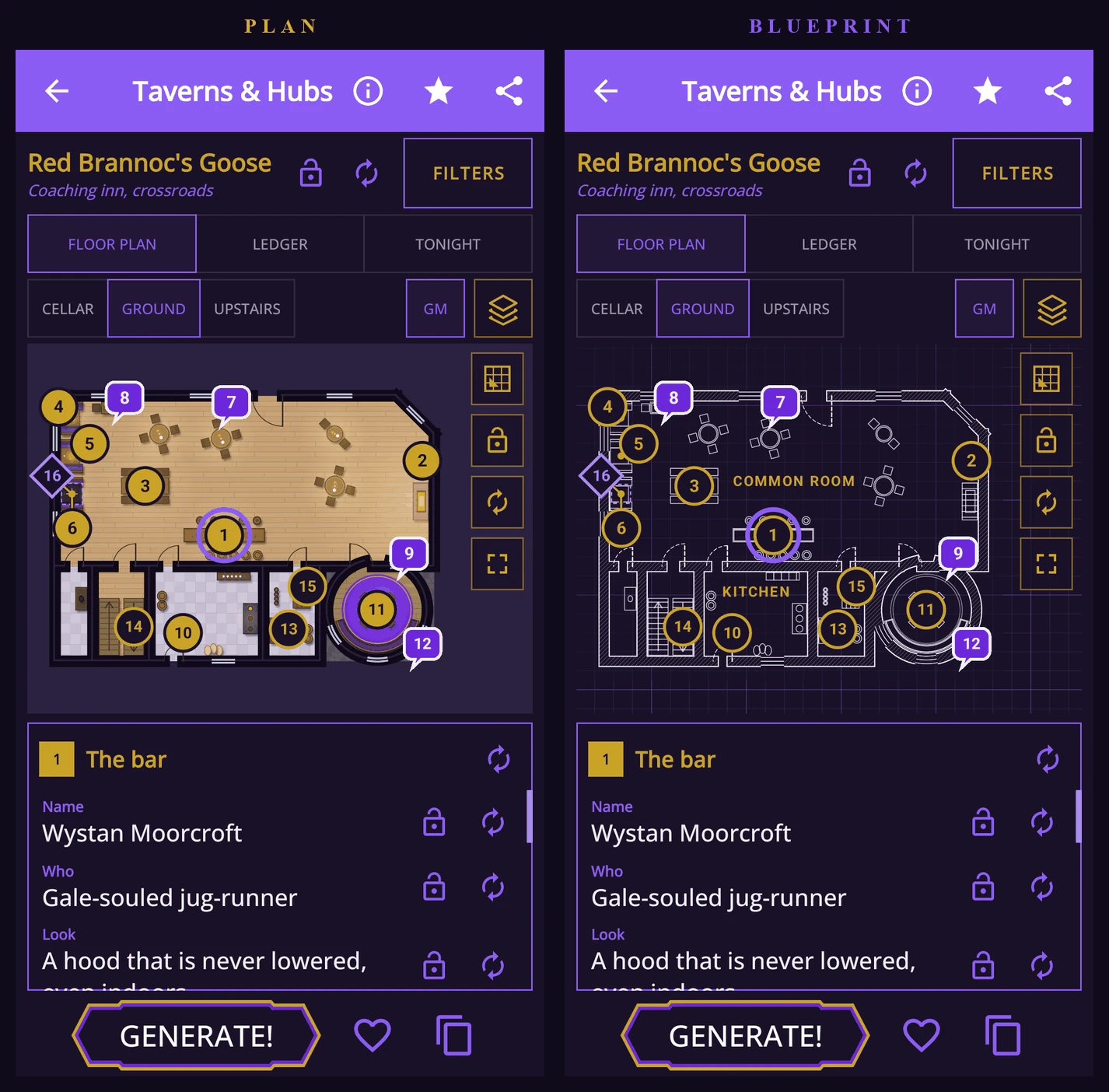 One ground floor, two styles: the plan on the left, the blueprint on the right. Pin 1 is the bar.
The furnished plan shows floorboards, tables and fittings. Switch to blueprint and the same rooms appear in white lines against a dark grid, with room names available when wanted. Layers determines which pins are visible, including people, talk, places and GM secrets; pinch and drag move across the drawing, and Fit restores the whole floor to view.
There are twenty-two venue types across fantasy, sci-fi and the 1920s. A mead hall offers a different starting point from a dockside dive, an orbital casino from a colony mess hall. Filters let you choose the location, size, shape, floors, wealth and mood, along with clientele, tone and how close the trouble is to breaking loose. A stage, games of chance and concealed material for the GM can be included. Leave a choice on Any and the generator settles it.
 Three floors of one inn: the cellar with its hidden room, the common room and kitchen, and the guest rooms upstairs.
The Ledger and the Secrets Below
Beneath the Goose is a hidden room with a tunnel leading away from it. The purse in the boot belongs among its secrets, alongside a band of retired adventurers planning one last expedition and arguing about who must carry the rope. Elsewhere, a concealed chamber might be a smugglers’ store, a forger’s workshop, a tomb or a cult’s meeting place, drawn from eight possible kinds.
The GM switch governs who gets to see that part of the building. With it on, hidden rooms, stashes, tunnels and the underlying trouble are visible. Turn it off and their pins and descriptions disappear, leaving the player-facing version of the venue. At the Goose, that means barrels and stores, with no hidden room marked on the plan. You can show the map across the table without revealing the passage beneath it. Copy follows the same setting, including secrets only when GM is on.
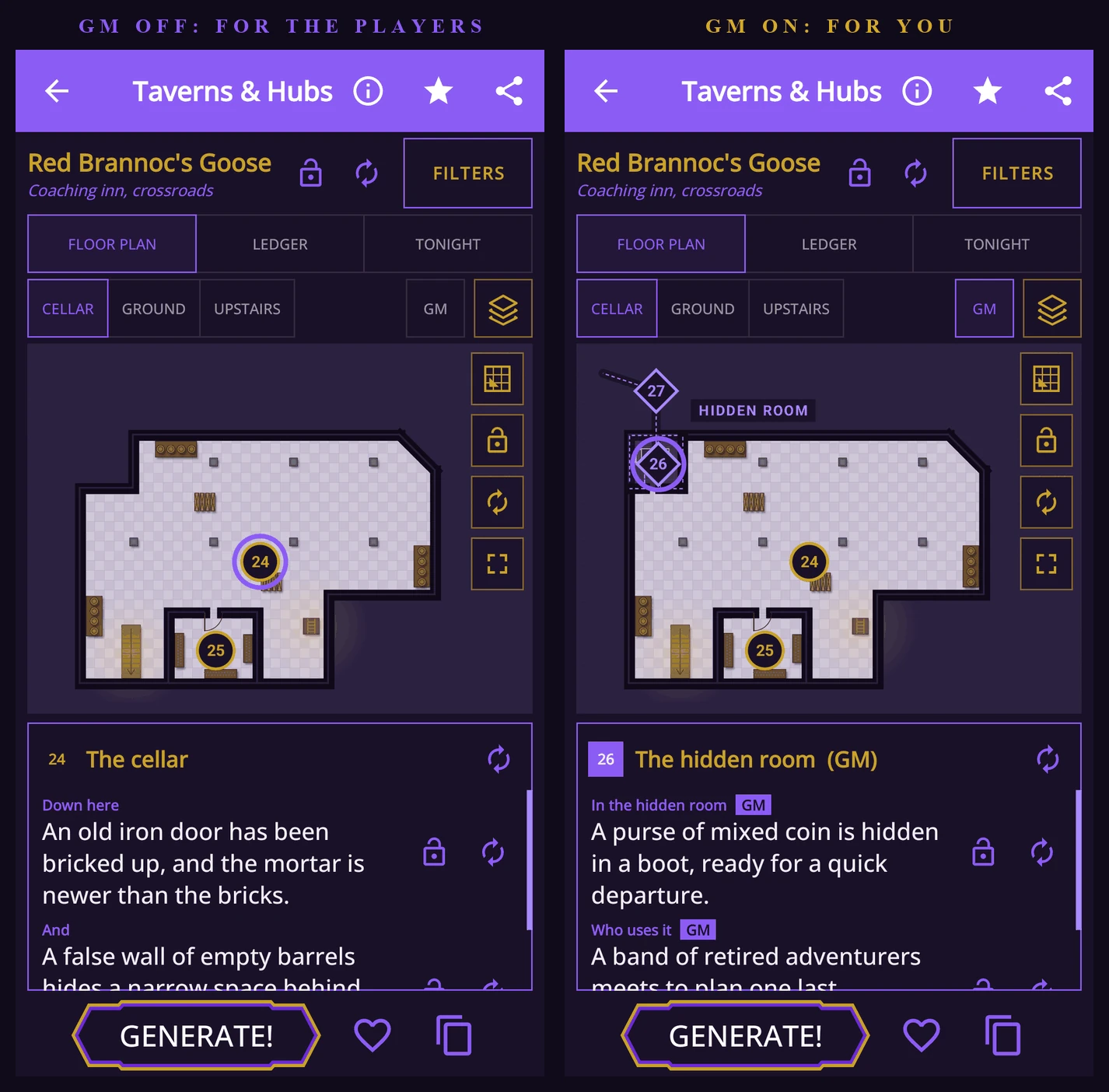 The same cellar twice. With GM on, the hidden room (26) and the tunnel (27) appear, and the panel tells you who uses it.
The Ledger gathers the venue into a page you can read before play: its owner, occupied spots, bill of fare and games, with the trouble included when GM is enabled. Locks and individual rerolls remain available there, so preparing for a session need not mean accepting every detail of the first result.
At the Goose, the menu is lettered down the handle of a wooden spoon the size of an oar. Drinks include a nightcap posset and a stirrup cup alongside the mulled cider; food follows, with a house special and something better avoided. Prices use bronze, silver and gold tiers, each with one to five pips. A legend explains their value in that establishment. Here, a bronze pip is about a copper, enough for a carter’s supper, while gold belongs to lords and the suddenly lucky. You can translate those prices into your campaign’s currency without rewriting the menu.
Games of chance come with playable rules, stakes, what is on the table, table talk and a private line identifying the cheat. In one generated speakeasy, the Lavender Tavern, Dead Man’s Deck places a card face down beneath an upturned glass. Players draw and wager on the concealed card; naming one already drawn means paying everyone at the table. The evening’s additional rule removes any card that touches the floor. Its dealer is a girl in pigtails and a party frock, and nobody can say whose daughter she is.
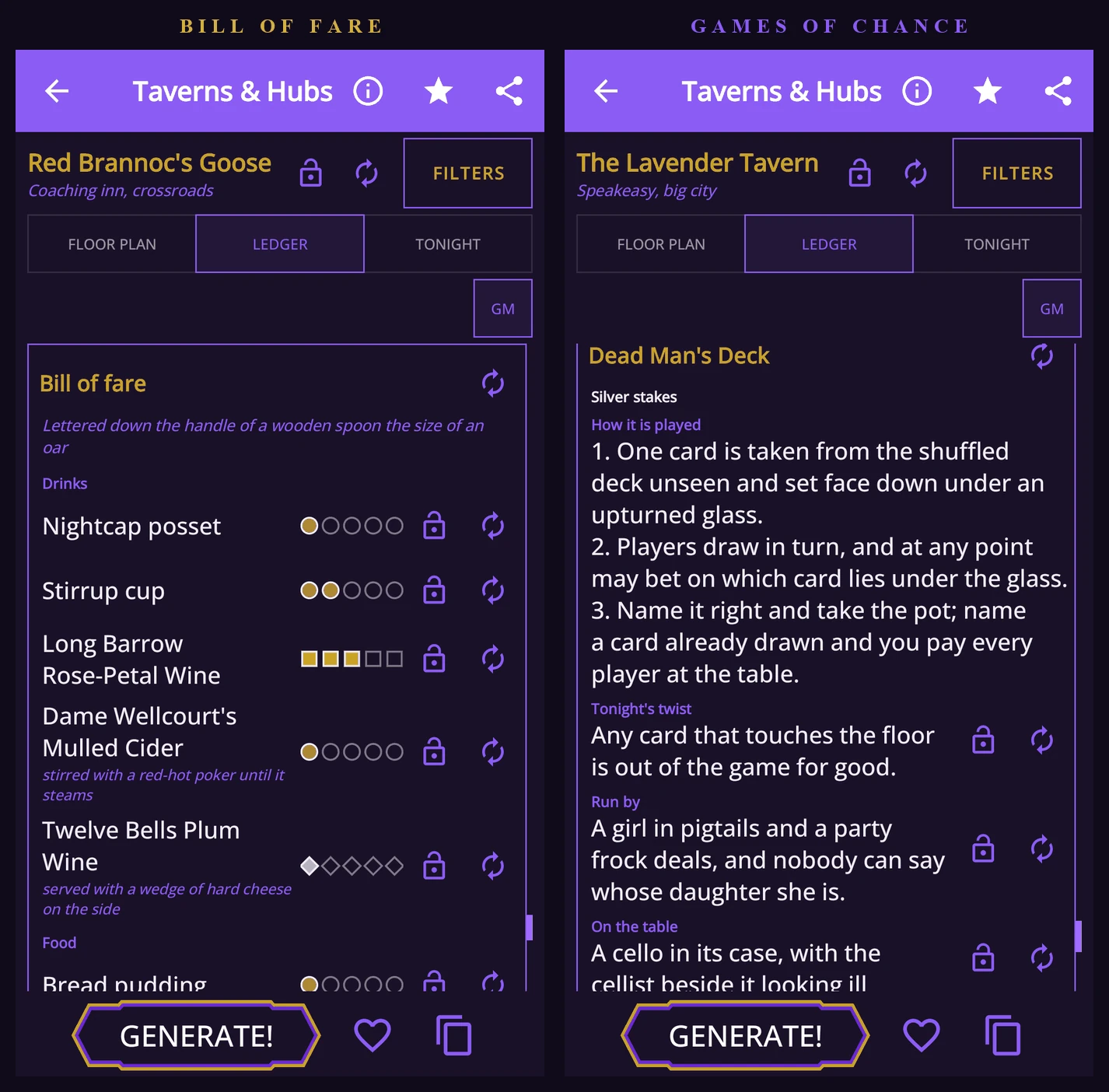 Left, the Goose’s bill of fare, priced in pips: the circles are bronze, the diamonds silver, the squares gold. Right, the rules of the Lavender Tavern’s card game.
Tonight, Hour by Hour
At half past six, a stranger sits on the Goose’s outside step and refuses to enter until called by name. An hour later, two old enemies recognise each other across the room and the talk around them dies. At half past eight, a spark lands in a sleeping drunk’s beard, and the company cheers him awake.
Tonight arranges events from opening to closing, with a ribbon showing the night’s overall shape and an hour and room attached to each occurrence. New Evening gives the same building another sequence. Send to Timeline transfers it into Timeline Maker, with lanes for the rooms and another for the trouble. There you can move events to different hours, add your own and save the result to Favourites. If you want the enemies to meet before the stranger arrives, you can arrange that meeting yourself.
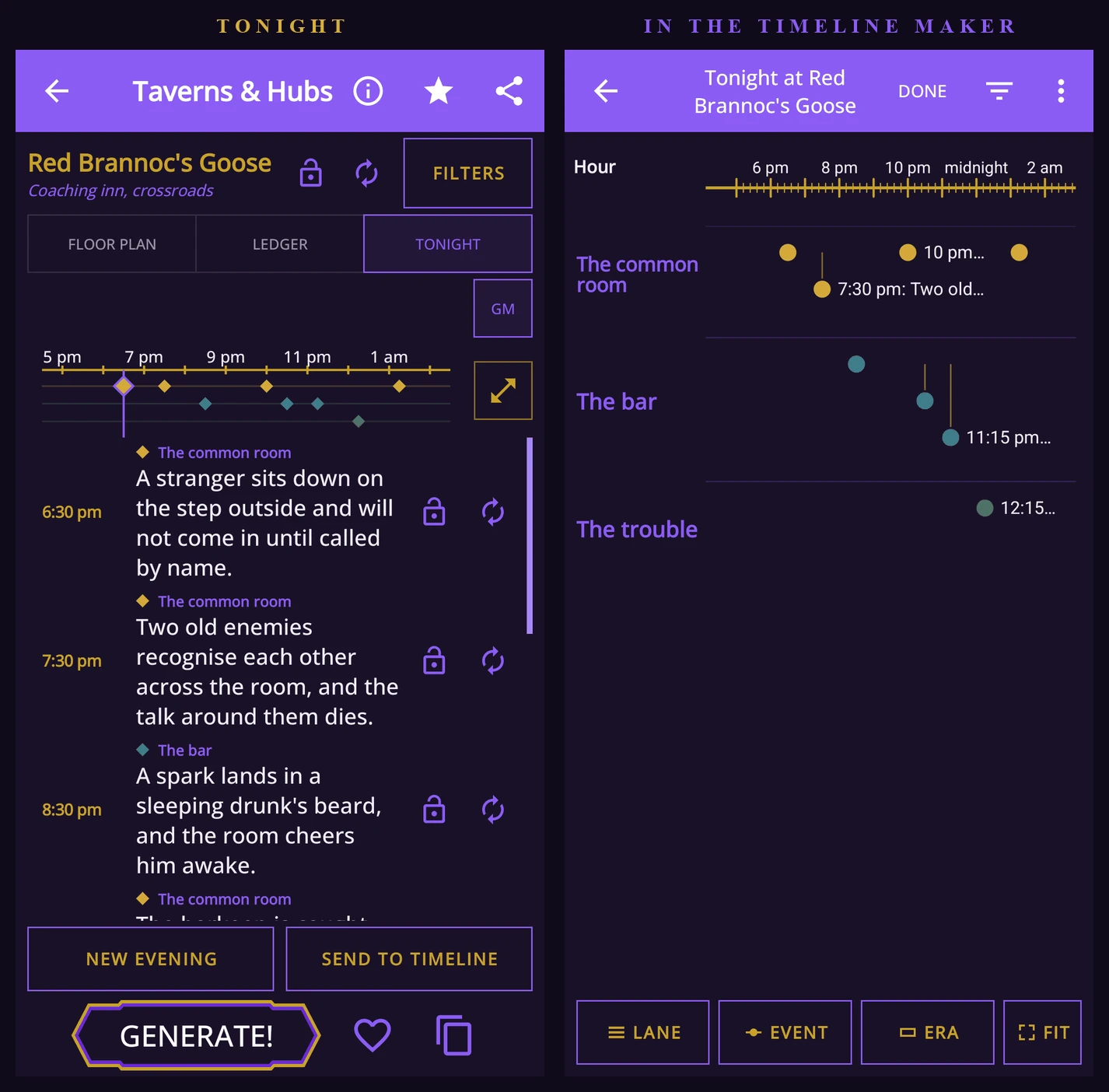 The evening at the Goose, hour by hour, and the same evening sent to the Timeline Maker.
A venue saved to Favourites reopens with its floor plan and occupants intact, and its lines still available to reroll. Attached to the Campaign Board, it opens as the map itself rather than a text attachment, ready to consult when the party returns.
Three Genres, from Mead Halls to Speakeasies
The same tool can furnish a cantina on a mining colony or a waterfront speakeasy. Its vocabulary follows the setting, down to a sci-fi sub-deck or a 1920s basement. One period menu is engraved on a brass plate unchanged since 1919, offering a free lunch with every second drink, if it deserves the name. Beneath the Lavender Tavern, a cellar extension has broken into an old colonial burying ground. The owner is selling off the grave goods. That knowledge stays with the GM until the story gives the players reason to discover it.
Fantasy and sci-fi venues draw some of their contents from other generators: Quest Hooks for a notice-board job, Found Notes for a letter in a guest room, Magic Items for a pawned object behind the bar, and the Bestiary for a cellar creature. The 1920s rooms have writing of their own, with occupants drawn from the NPC generator’s new period-horror register. One such character is Delphine Hale, an engineer and shipwreck survivor who cannot abide silence and wants a single night’s sleep without the drowned bell. You might choose to let that bell trouble a story long before you decide what is ringing it.
 Red Brannoc’s Goose, Club Rat (a cantina in a core city) and Bones McAvoy’s Grotto (a speakeasy on the waterfront).
With 4.37, every tool that offers a genre choice supports fantasy, sci-fi and 1920s horror. In the NPC generator, period names and a background replace the fantasy name and race. The new register reaches Quest Hooks, Rumours, Encounters, the Bestiary, Found Notes, Omens, Mystery, Random Places, the dice Oracle, Magic Items, Dungeon Rooms, Five Room Dungeon, Adventures and Factions. Period roles, quirks, wants and secrets accompany the NPCs. You can build beyond the speakeasy, following a town’s rumours towards the house on the hill, with characters, creatures and clues drawn in the same register.
Sci-fi reaches Random Places, Magic Items, Omens, Found Notes, Dungeon Rooms, Five Room Dungeon, Adventures and Factions for the first time. Its tables now match their fantasy counterparts in size, with more than 5,700 new lines added. A sci-fi Oracle session offers only compatible generators. Realm, Faith, Dynasty, the History and World Engines, and Campaign Assembler remain fantasy tools.
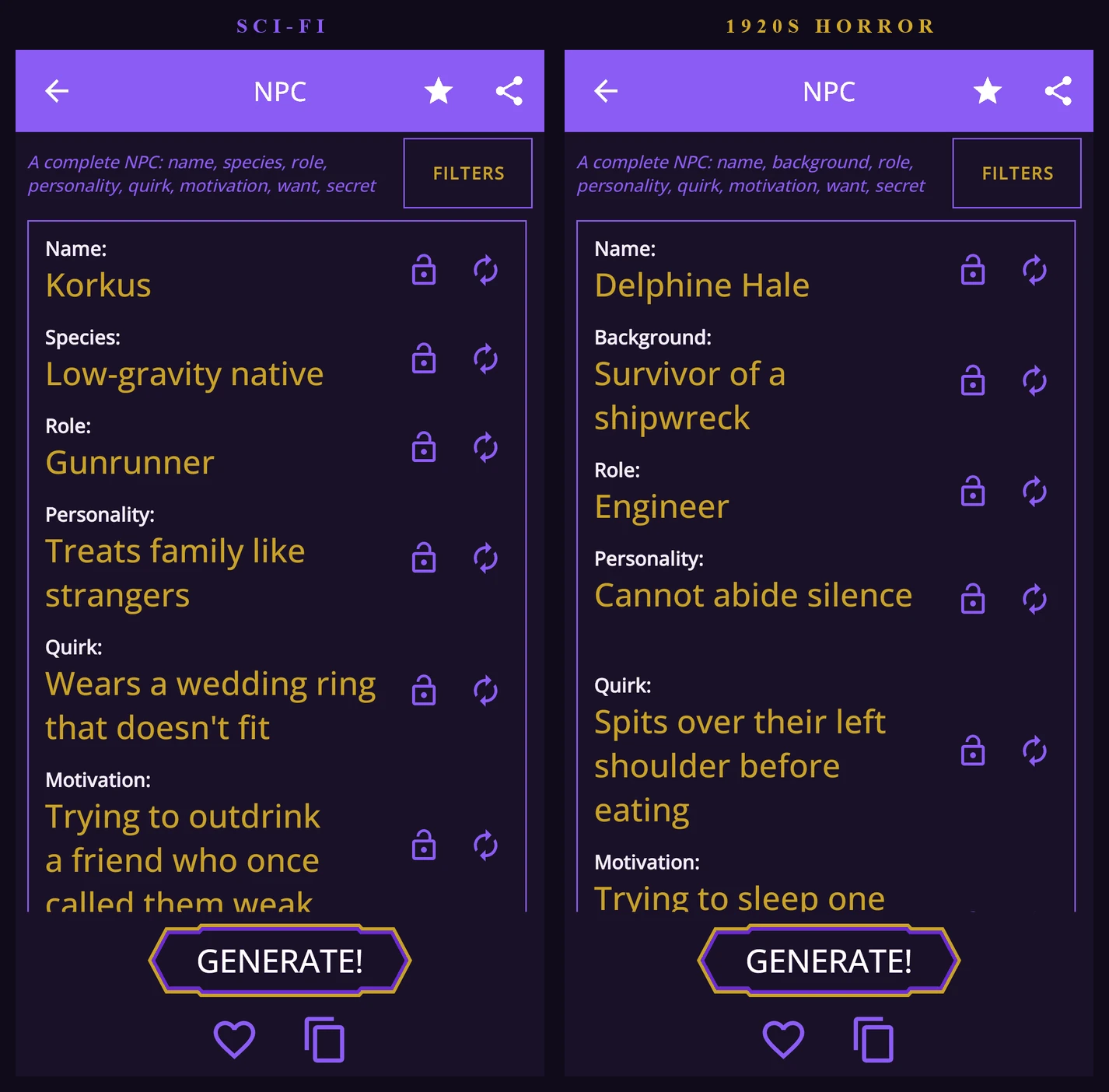 The NPC generator in sci-fi and in its new 1920s horror genre, where a background takes the place of a species.
The Whole Tarot, Beyond the Reading
The Tarot Oracle Engine now holds all seventy-eight cards. The fifty-six Minor Arcana have illustrations in the Majors’ style and meanings of their own. Deck settings let you draw from the whole pack, the Majors alone or the Minors alone.
Readings have become clearer about what they offer. A plain yes or no carries the card’s meaning; further prompts belong to And, But or Exceptionally results. Beneath the verdict, a calculation shows the card’s contribution alongside the roll. Drawing a card twice within a session produces different wording on its return. Twist draws on that card’s voice, and a Major appearing as a Figure is presented as a person. Interpretation remains with you: the deck supplies material for the question you bring, and you decide how it belongs in the fiction.
The Tarot also connects more closely with a dice Oracle campaign. An exceptional answer can move Chaos, with a menu switch controlling that behaviour. You can check whether a scene ended in or out of control; random events can involve established NPCs and threads, and a Figure can join the NPC list. A person suggested by a card can therefore remain in the campaign after the reading that introduced them.
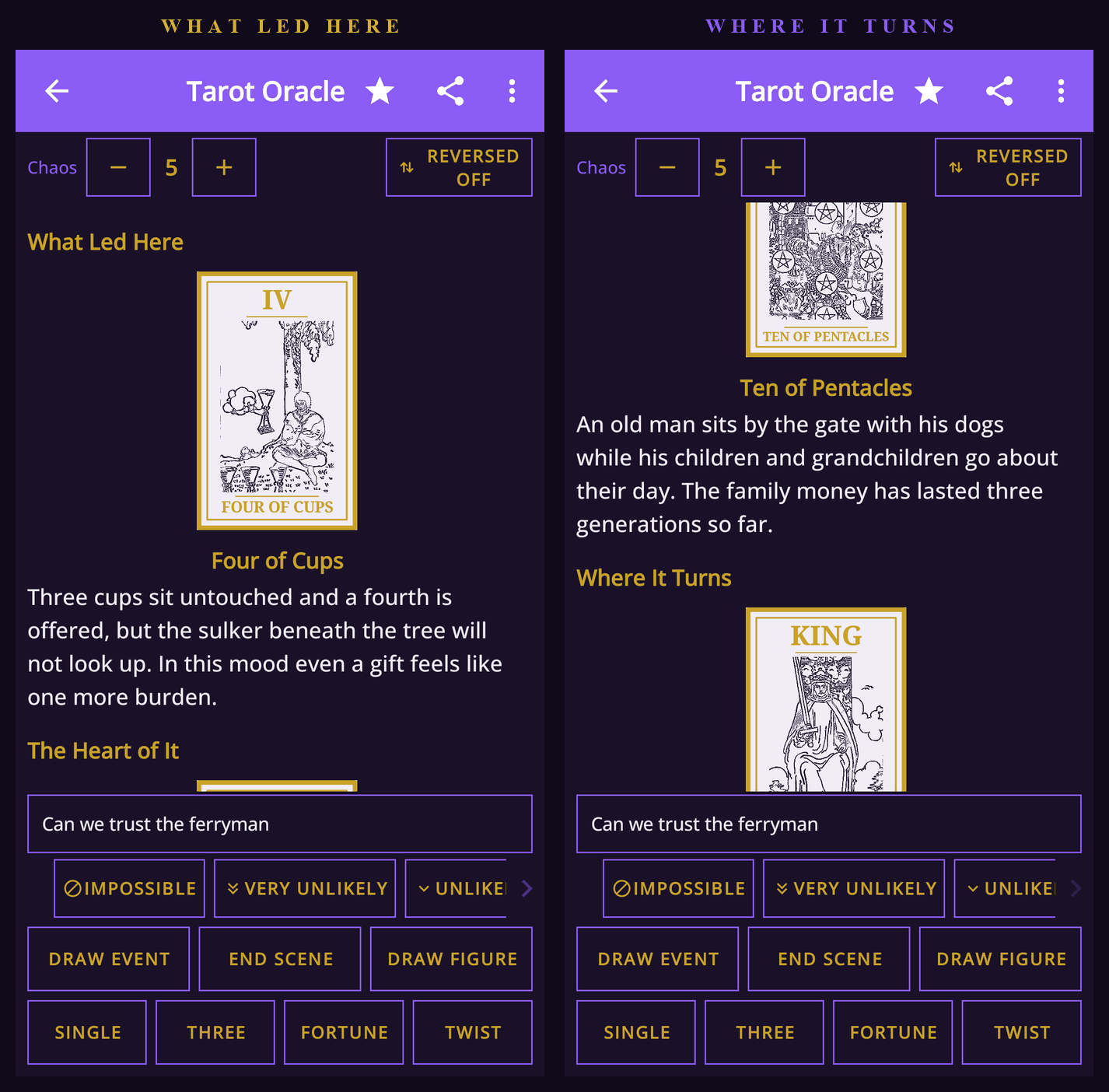 Three Minor Arcana in one spread: What Led Here, The Heart of It and Where It Turns.
Campaign Assembler Leaves Beta, and Chronicles Carry On
Campaign Assembler has left beta. Packs take their adventure’s name, NPCs include a Want and a Secret, and quests carry a Deadline. Saved packs reopen in the Assembler for further changes, display correctly on the Campaign Board, and have PDF titles that fit their pages.
In the Oracle, Bring it to life now reaches world-building tools, with a realm’s ruling house or faith generated to suit it. Returning an adventure to the Oracle adds its villain, lieutenant, ally and wildcard to the NPC list. Voyage jobs give a destination and pay the balance on arrival.
The World Engine’s Open as Realm carries a chronicle’s realm into the Realm Generator in its final state. For chronicles saved from 4.37 onward, timelines use short event titles with the full sentences retained as notes, bars for reigns and factions, ages named for their reigns, and wars visible on both participating realms’ lanes.
Better Maps and Results That Fit Together
On Fantasy Map and Hex Map, rivers now rise at springs on high ground and descend towards a sea or lake, gathering tributaries and widening towards their mouths along a single line. On Hex Map they pass from hex to hex, avoiding mountains and settlements.
Treasure Map, Town Map, Star Chart, TOPO//SCAN, Hex Map, Sector Survey and venue plans place names beside their subjects and clear of lines and symbols. Five Room Dungeon numbers sit on filled badges; openings in sigil charges such as keys and coins are now visible; the full-screen map viewer gains Fit. Existing maps retain their drawings. The changes apply to maps generated from 4.37 onward.
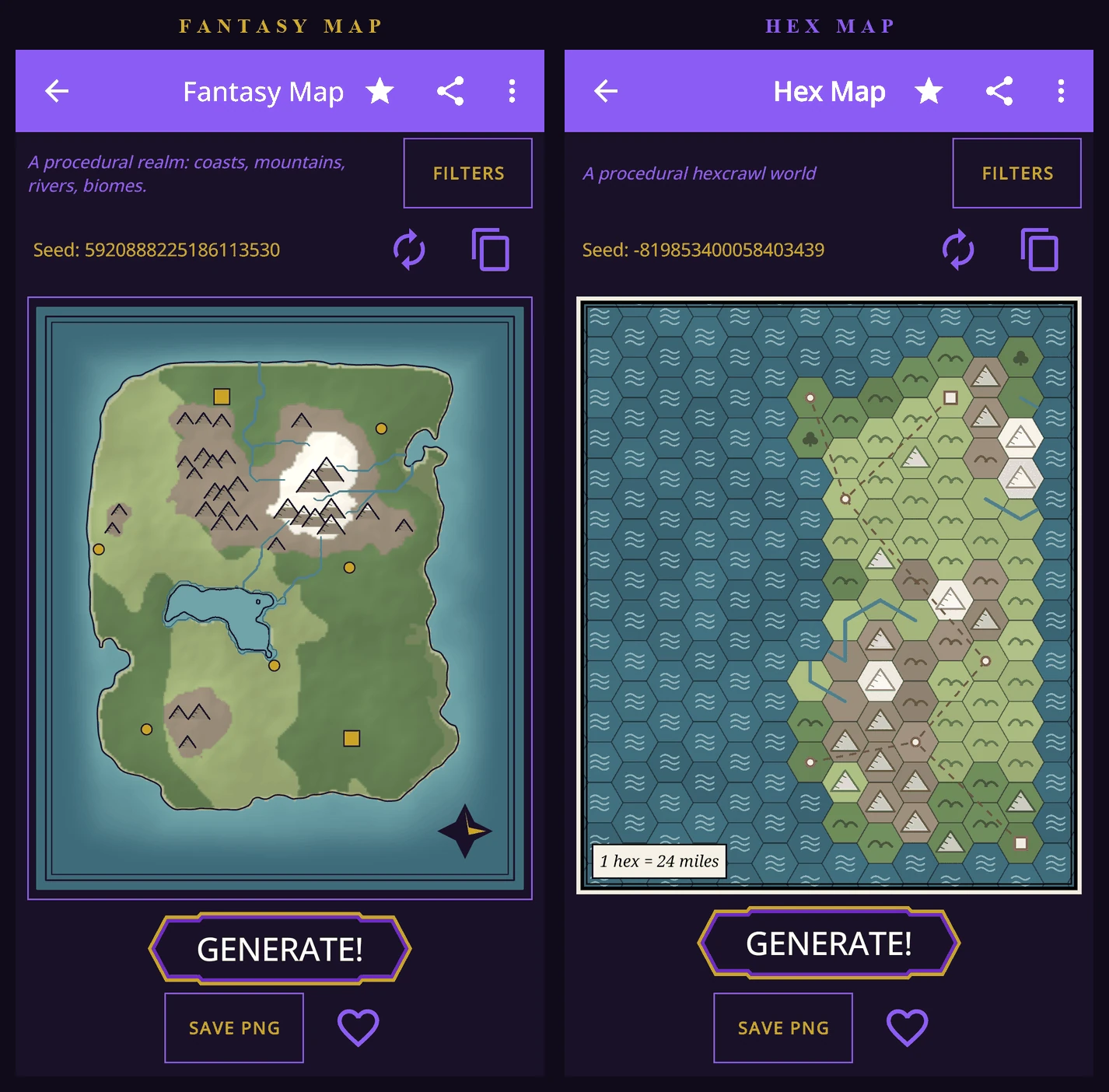 Rivers that start in the hills and end in the sea, on the Fantasy Map and the Hex Map.
Encounter stakes fit their scenes, a faith’s worship matches its structure, and rerolled creature statistics suit the description. Rulers, heirs and founders draw from 150 names per gender rather than twenty-six, with no given name repeated among a single world’s realms. House names in the name generator cover the alphabet, and new faction crests keep rockets and satellites out of fantasy and period settings.
Bigger Text, New Names and the Saves You Keep
The app now follows your phone’s font size up to 130%, with screens accommodating that increase. Rotating the phone preserves results, locks, open panels and popups, and your reading position.
Twenty-eight NPC race names borrowed from other publishers’ games have been replaced with names of our own, including Mothfolk, Oathwrought and Shellback. Saved NPCs retain their original text. New app wording uses British spelling. UnifrakturMaguntia has left the list of selectable fonts, although an existing selection stays in use until you choose another.
Your existing favourites, presets, notes, campaigns, maps and settings remain available after the update; saved generated material keeps the wording and drawings it already had.
Fantasy World Generator 4.37 is available now on Google Play, free, fully offline and with no account required. Open Taverns & Hubs and choose somewhere your next session might gather. The Goose offers a cellar passage and retired adventurers still quarrelling over the rope; another roll will give you a different company to keep. You decide which room deserves attention, when the evening’s trouble arrives, and what your players find when they go looking beneath the inn.
Download Fantasy World Generator
At the Goose, the stranger waits on the step for someone to speak his name. Make a venue of your own, and decide who is waiting outside.